
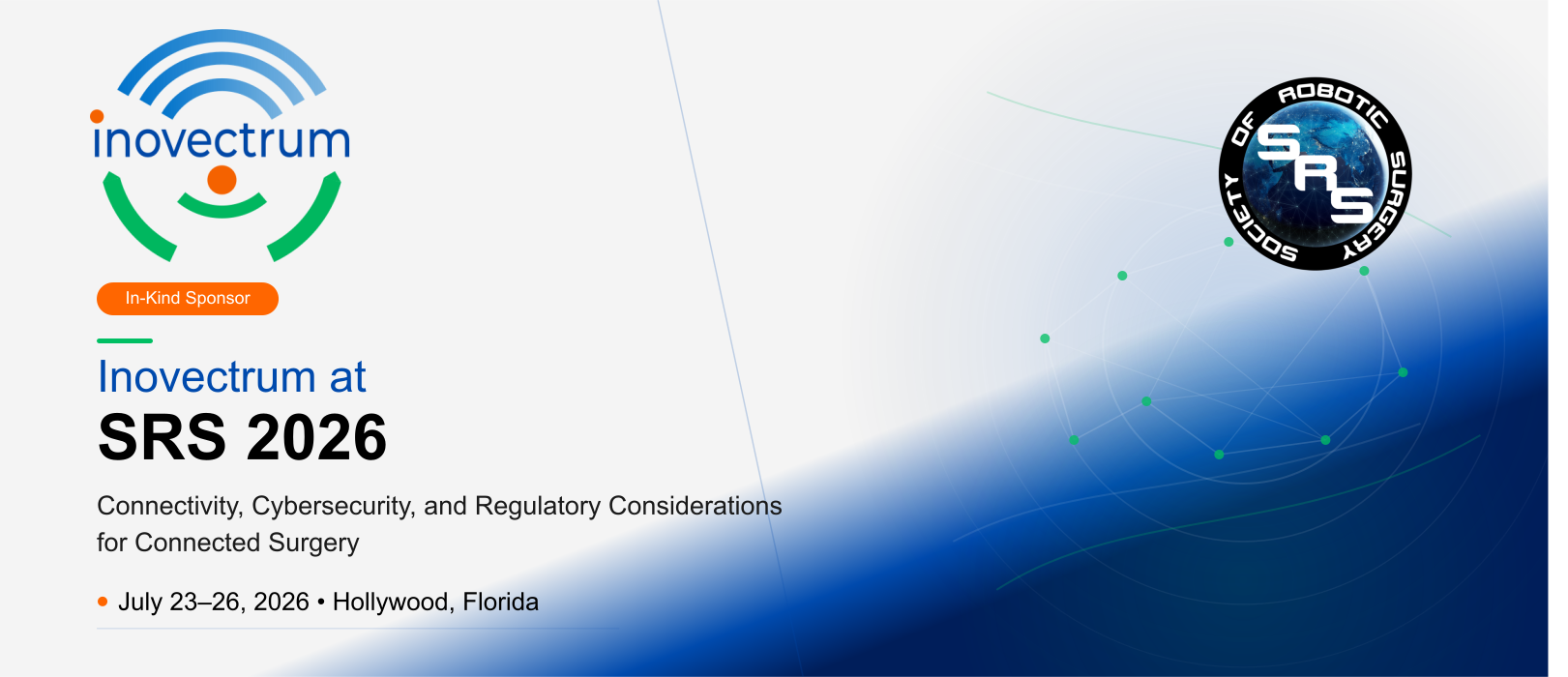
Inovectrum will participate in the 2026 Society of Robotic Surgery Annual Meeting, taking place July 23–26, 2026, in Hollywood, Florida.
The meeting brings together surgeons, robotic surgery companies, digital health stakeholders, health systems, and technology leaders to discuss the continued development of robotic and connected surgery. Inovectrum is also proud to be an in-kind sponsor for this year’s meeting.
For Inovectrum, the meeting is closely aligned with our work at the intersection of medical device connectivity, wireless systems, cybersecurity, regulatory strategy, and connected clinical environments.
Connected surgery depends on more than the robot
Robotic surgery and telesurgery are often discussed through the lens of surgical capability and robotic system performance. Those remain central. However, as surgical systems become more connected, the supporting infrastructure becomes increasingly important.
Telesurgery depends on the interaction between robotic systems, telecom infrastructure, cybersecurity controls, clinical workflow, and regulatory expectations. Performance cannot be evaluated only at the device level. It also depends on how the system behaves across real networks, clinical environments, support models, and operational constraints.
This is especially important as telepresence and telesurgery move from controlled demonstrations toward broader clinical use. Issues such as latency, jitter, reliability, redundancy, authentication, network monitoring, cybersecurity, and failure response become part of the safety and effectiveness discussion.
SRS sessions involving Inovectrum
At SRS 2026, Omar Al-Kalaa, PhD, Founder and Principal Technologist of Inovectrum, will participate in several sessions focused on telesurgery, Digital OR infrastructure, cybersecurity, telecom requirements, and regulatory considerations.
His roles include:
- Moderator for Robot Technical, Cybersecurity, and Telecom Requirements
- Co-chair for Digital OR: Data Collection, Analytics, and Cybersecurity
- Panelist in global and military telesurgery discussions, including implementation considerations for telesurgery in different countries and health systems
These sessions address related questions from different angles. What technical and telecom requirements are needed for telesurgery? How should cybersecurity be incorporated into connected surgical systems? What regulatory, legal, and ethical frameworks are needed for remote surgical care? How can Digital OR data be collected, protected, interpreted, and used across systems?
Digital OR and the data infrastructure problem
The Digital OR is not simply an operating room with more digital tools. Modern operating rooms already include robotic systems, imaging, video, connected devices, displays, hospital IT systems, and documentation workflows. Each system may generate useful data. The difficult question is whether that data can be collected, transmitted, protected, and interpreted in a way that supports clinical, operational, and research use.
Digital OR development depends on data collection, interoperability, analytics, cybersecurity, and trustworthy data movement. It also depends on decisions around open and closed architectures, data ownership, workflow integration, and the practical limits of deploying connected systems across different hospitals.
For connected surgery to scale, these questions need to be addressed as part of system design and deployment, not as afterthoughts.
Inovectrum’s role in connected clinical environments
Inovectrum works with healthcare innovators developing wireless and connected medical technologies. Our work includes wireless system design and integration, regulatory strategy, EMC and wireless coexistence support, healthcare connectivity planning, and technical guidance for connected clinical environments.
These areas are directly relevant to the infrastructure layer behind connected surgery. As surgical systems become more data-rich and network-dependent, questions around wireless performance, network behavior, cybersecurity, interoperability, and regulatory expectations will continue to shape what can be deployed safely and sustainably.
SRS 2026 provides a timely venue to discuss these issues with stakeholders across surgery, industry, hospitals, telecom, digital health, and medical device development.
Connect at SRS 2026
If you are attending SRS 2026 and working on connected surgery, telesurgery, medical device connectivity, cybersecurity, Digital OR infrastructure, or clinical wireless systems, we would welcome the chance to connect.

Connect With Us
Inovectrum partners with medical device developers, telecommunications providers, testing laboratories, and policy leaders to advance the future of connected healthcare. Reach out by email, phone, or through the contact form — we look forward to connecting with you!